Service Details
Discover the depth of our services and how they can transform your business. Our team is dedicated to delivering high-quality solutions tailored to your unique needs. Read on to learn more about our expertise and how we can help you achieve your goals.
Get Started Today!
Contact us to learn more about our galvanizing services and how we can help protect your steel structures. Our team is ready to assist you with your galvanizing needs.

Our Galvanizing Services
At Galavanizing Services LLC, we pride ourselves on delivering exceptional galvanizing services that shield steel structures from corrosion, ensuring unparalleled durability and longevity. With cutting-edge facilities and seasoned experts, we provide top-tier galvanizing solutions for diverse industries.
- Construction
- Infrastructure
- Industrial
Why Choose Our Galvanizing Services?
- Expertise: Our team has extensive experience in galvanizing, ensuring that every project meets the highest standards of quality and reliability.
- Advanced Facilities: Our modern facilities are equipped with the latest technology, enabling us to handle large and complex projects with ease.
- Customer-Centric Approach: We prioritize our clients' needs, offering personalized solutions and exceptional customer service.
- Competitive Pricing: We provide top-quality galvanizing services at competitive rates, ensuring value for our clients.
- Quality Control: We adhere to strict quality control measures, guaranteeing that every product meets our high standards.
- Sustainability: Galvanizing is a sustainable and environmentally friendly process that extends the life of steel structures, reducing the need for frequent replacements.
Galvanization
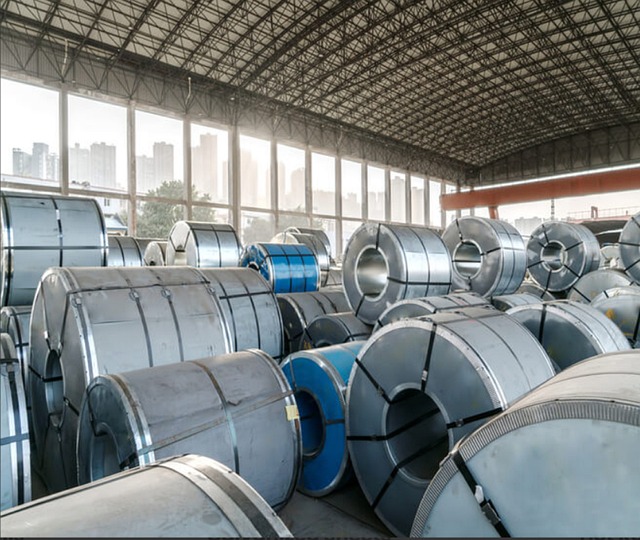
Galvanization is the process of applying a protective zinc coating to steel or iron to prevent rusting and corrosion. The most common method is hot-dip galvanizing , where the metal is dipped into molten zinc.Protects iron or steel from oxidation (rust).Galvanization provides a sacrificial layer that corrodes instead of the underlying metal. Increases durability and lifespan of metal structures. Cost-effective way to prevent corrosion.
How It Works :
Zinc acts as a sacrificial anode , meaning it corrodes preferentially,
protecting the underlying steel or iron. Even if the coating is slightly
damaged, the zinc will still protect the exposed area.
Common Methods :
Hot-dip Galvanizing,
(Immersing metal in molten zinc)
Electro-Galvanizing
(Using electroplating to deposit a layer of zinc) and
Spraying(Applying zinc coating via thermal spraying)
Why Galvanize
- Prevent Rust and Corrosion
- Prolong Lifespan of Structures
- Cost-Effective Protection
- Enhanced Durability
- Improved Aesthetics
- Eco-Friendly Solution
Hotdip Galvanization
Hot dip galvanizing is a process in which steel is coated with a protective layer of zinc by immersing it in molten zinc. This coating forms zinc-iron alloys on the surface, providing excellent corrosion protection, strength, and durability. It is widely used in construction, infrastructure, and transportation due to its economic efficiency and long-lasting protection.
Advantages of Hotdip Galvanization
- Long-Term Corrosion Protection
- High Level of Mechanical Resilience
- All-Round Protection even in cavities and edges
- Cathodic Corrosion Protection
- Attractive and Uniform Appearance
- Cost-Effective and Economical
- Maintenance-Free
- Environmentally Friendly Process
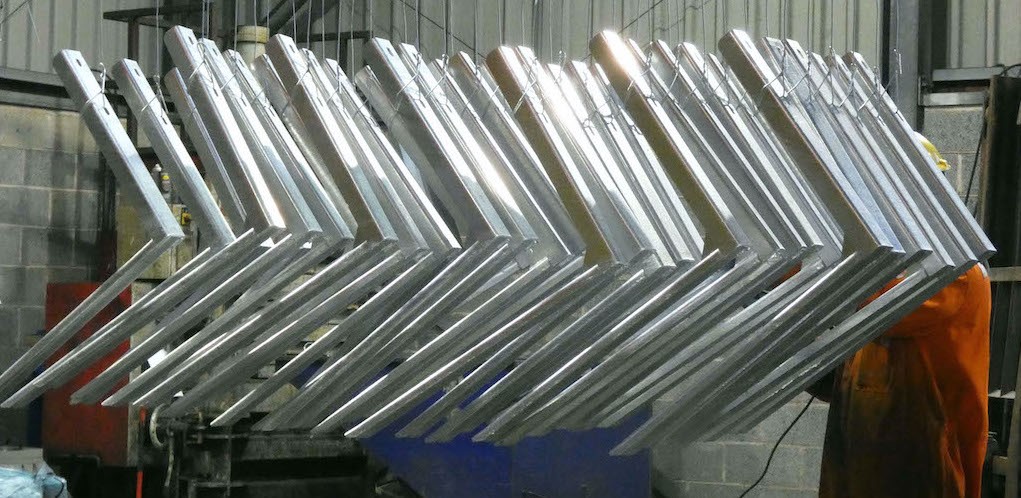
Applications of Hotdip Galvanization
- Bridges
- Highway Guardrails
- Steel Structures and Barriers
- Car Parks
- Marine structures
- Automotive Parts&Components
Surface Preparation
Most metallic articles that are usually given protective coatings are heavily contaminated and require, at least, some cleaning treatment before the coating is applied. The importance of surface preparation cannot be over emphasized as many investigations have shown convincingly that the performance and durability of any protective coatings are, to a large extent governed by the thoroughness of surface preparation. Often they concluded that careful cleaning and preparation of the surface were more important than the quality of the protective coating. Surface contamination in the form of rust, scale, oil grease and dirt must be removed before painting. Invisible contamination may also be present and represents, on the whole, a greater hazard. Examples of the latter are soldering fluxes, perspiration in the form of hand marks, chlorides from a Marine atmosphere and sulphite from industrial atmosphere.
Standards for Surface Preparation
- Swedish Standards
- Steel Structures Painting Council (SSPC)
- NACE Standards
- ISO 4624, ISO 2802
Working Profile for Painting
We offer a full range of surface preparation and protective coatings as follows:
- Blasting & Painting: Abrasive blasting and high-quality coating of steel components.
- Paint Stripping: Chemical or mechanical removal in sensitive areas like turbines and motors.
- High Pressure Water Jetting: Efficient cleaning and degreasing for industrial surfaces.
- Steam Cleaning: Effective method for degreasing prior to coating.
- Conventional Grit Blasting: Uses various abrasives to achieve surface profiles that meet coating specifications.
- Wet Abrasive Blasting: Reduces dust; suitable for confined or dust-restricted environments.
- Chemical Cleaning: Ideal where blasting isn't possible; leaves a clean surface ready for coating.
- Power Tool Cleaning: Uses tools like grinders and needle guns for small-scale or budget-friendly surface prep.
Abrasive Blasting
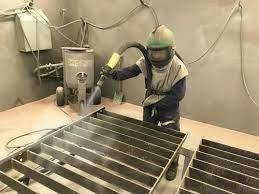
Abrasive blasting is a highly efficient method of surface preparation used to clean, roughen, or smoothen surfaces by forcibly propelling abrasive material at high speed against them. It is a compulsory process before coating, painting, or galvanizing in order to attain maximum adhesion and a long-lasting finish.
- Surface Cleaning: Removes rust, scale, old paint, grease, and other impurities.
- Surface Profiling: Creates a rough surface ideal for coating adhesion.
- Custom Finishes: Creates varying degrees of surface profiles (Sa1 to Sa3) to project specifications.
Applications of Abrasive Blasting
- Surface Preparation for Coatings
- Rust and Paint Removal
- Cleaning Industrial Equipment
- Restoration of Historic Structures
- Etching and Texturing Surfaces
Sweep Blasting
Sweep blasting is a specialized abrasive blasting technique that uses a controlled stream of abrasive material to clean and prepare surfaces. Unlike traditional blasting methods, sweep blasting allows for precise control over the area being treated, minimizing overspray and reducing waste. This method is particularly effective for cleaning large surfaces, removing coatings, rust, and contaminants while preserving the integrity of the underlying material. Sweep blasting is commonly used in industrial applications, including shipbuilding, construction, and manufacturing, where surface preparation is critical for ensuring the longevity and performance of protective coatings.
Painting
The purpose of painting/coating application is to develop a continuous highly adherent film with an even thickness over the substrate. To achieve this, various factors have to be considered such as type of coatings and weather conditions, application methods etc.
Application Restrictions
- Do not apply coatings during fog, mist, rain, or when RH ≥ 85%.
- Avoid application when surface/ambient temperature is <10°C (50°F) or>50°C (120°F).
- Steel surface must be at least 3°C (5°F) above the dew point
- Humidity and dew point must be recorded using a sling psychrometer every 4 hours during application.
- Coatings shall only be applied after surface inspection and approval.
- Sharp edges must be ground to a minimum 2 mm radius, followed by stripe coating.
- Salt-contaminated areas (e.g., salt spray zones) must be cleaned with fresh water blasting/mopping before primer and intermediate coats.
- Water used should have chloride content ≤ 50 ppm.
Airless Spray Painting
➢ For applying the complete range of industrial coating system.
➢ For
Painting: We
have 2 painting yard with a capacity of 300 Ton per month
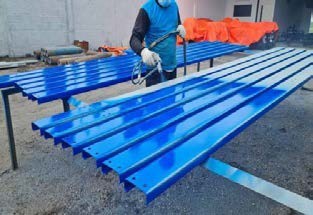
Advantages of Airless Spray Painting
- High Efficiency: Airless spraying delivers a high volume of paint quickly, making it ideal for large surfaces.
- Even Coating: Provides a smooth, uniform finish with fewer brush marks and streaks.
- Versatility: Suitable for a wide range of coatings, including thick paints and primers.
- Reduced Overspray: Compared to traditional spraying methods, airless spraying minimizes overspray, reducing waste and cleanup time.
- Better Adhesion: The high pressure used in airless spraying helps the paint adhere better to the surface.
Fireproof Painting
Intumescent paint is a coating that, when exposed to high heat, expands and forms an insulating char layer. This char protects the underlying steel by slowing heat transfer. The reaction typically begins at around 200 °C or more. The char layer thickness can expand many times over the original coating thickness (sometimes 50× or more) to provide protection. Fire protection durations range from 30 minutes up to 180 minutes or more, depending on coating type, thickness, and structural requirements.
Intumescent coatings are commonly used in commercial buildings, industrial facilities, and infrastructure projects to enhance fire safety and protect structural steel elements from collapse during a fire event.
- Allowing firefighters more time to get the fire under control
- Extending crucial evacuation time
- Fire protection for up to 120 minutes.
- Preventing structural collapse
Epoxy Painting
Epoxy coatings are a type of protective finish made from epoxy resins and hardeners. They form a durable, chemical-resistant layer that adheres strongly to surfaces like metal, concrete, and wood. Epoxy coatings are commonly used in industrial, commercial, and residential settings to protect floors, walls, and equipment from wear, corrosion, and chemical damage. They provide a tough, long-lasting surface that is easy to clean and maintain.
Advantages of Epoxy Painting
- Durability: Epoxy coatings are highly durable and resistant to wear, making them ideal for high-traffic areas.
- Chemical Resistance: They offer excellent resistance to chemicals, oils, and solvents, protecting surfaces from damage.
- Adhesion: Epoxy coatings adhere strongly to a variety of surfaces, ensuring a long-lasting finish.
- Aesthetic Appeal: Available in a range of colors and finishes, epoxy coatings can enhance the appearance of surfaces.
- Easy Maintenance: The smooth, non-porous surface of epoxy coatings makes them easy to clean and maintain.